User Experience Design

Women In Politics

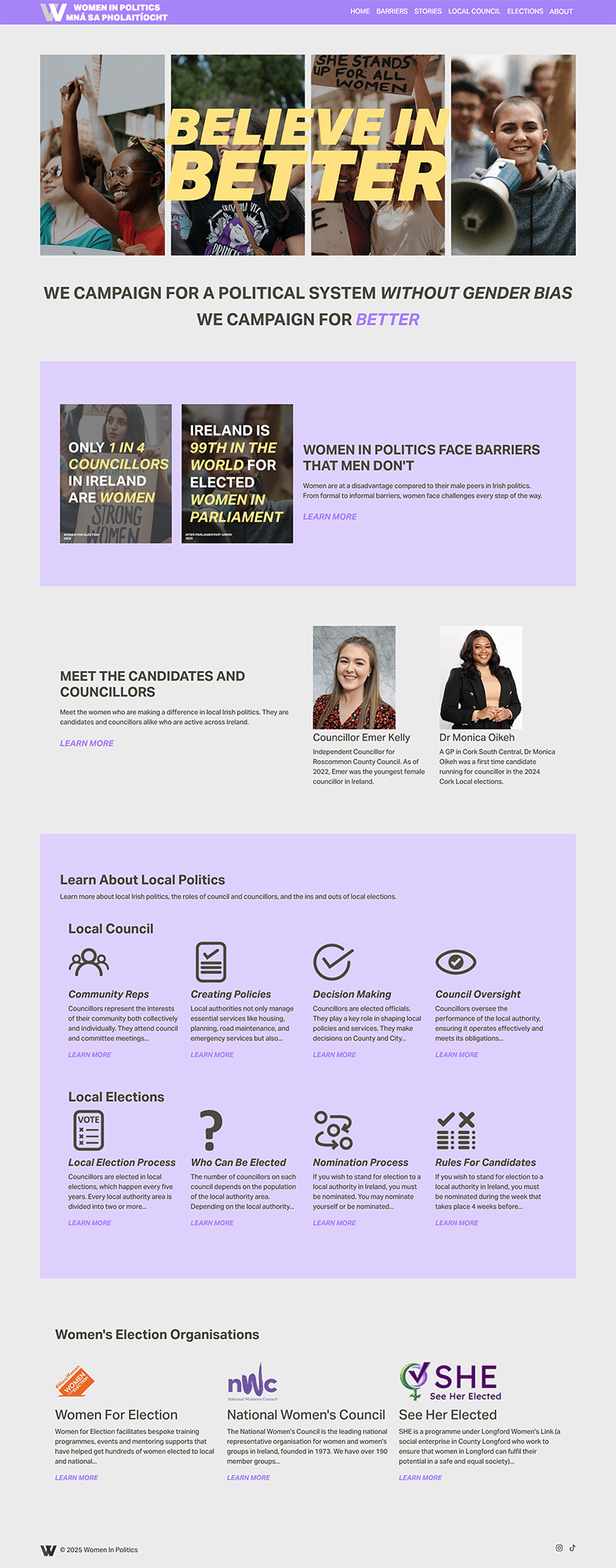
An educational and awareness campaign dedicated to increasing the number of young women in politics, through raising awareness, inspiring action and the provision of educational resources.

people playing basketball outside

A study in contrasts: light, shadow, and the rhythm of the game.

Background & Problem

Women in Politics is a university project aimed at creating an educational and awareness campaign surrounding women in politics.

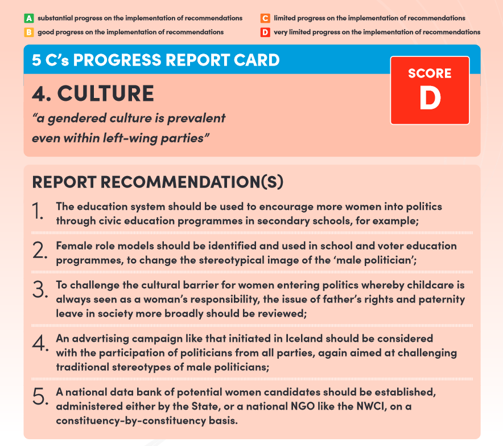
Through my research I found that bias permeates everyday life in a range of ways, from childhood gender norms and roles to the diversity of orchestras and the participation of women in politics. This research highlighted a range of eye-opening statistics and research to back up this issue as well as a number of barriers for anyone looking to learn more.

The primary project aim was to highlight the low number of women in politics, the causes of this low participation, and to elevate the current women actively participating in politics. The secondary project aim was to freely provide information about getting involved in politics to individuals that wouldn’t otherwise know where to start.

Project Definition

Through my initial research I decided that I wanted to create a project that had the most potential to positively impact women across the board. I decided that a project involving local level politics that elevates the existing women in Irish politics and encourages young women to see themselves as capable of being politicians, was the right path to achieve this goal. This was to be completed through the use of Digital Media, Print Media and Social Media.
two people sitting on a ledge talking

Venice, and a moment between two.

The Team & Key Influences

As this was a final year university project the research and execution was completed by myself and supervised by my university lecturer Kat Nolan, without Kat’s support my project wouldn’t be what it is today.

Throughout my work, I was supported in my research by politicians, political candidates, non-profit women’s charities, family and friends. All which contributed to my work through interviews, testing and reviews.

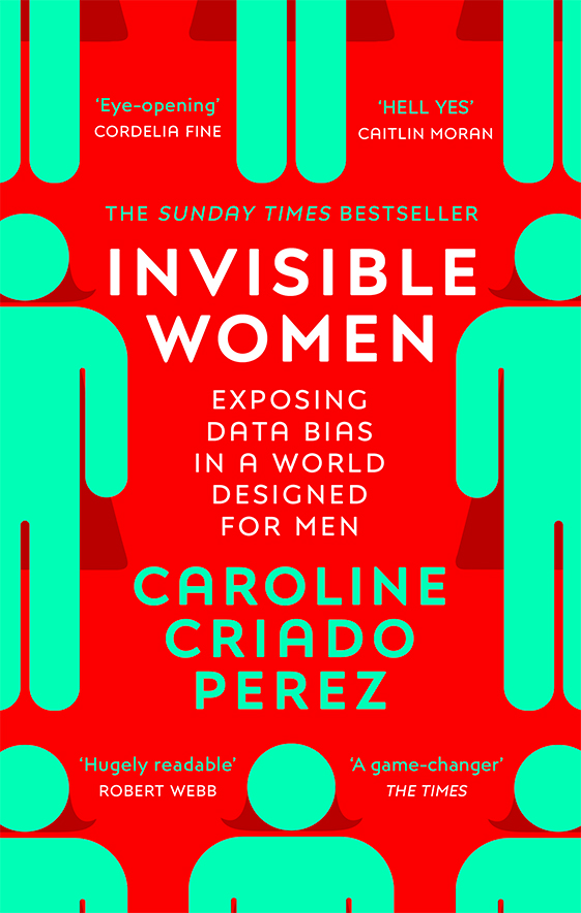
Key influences on my work include Caroline Criado Perez’s Invisible Women - a summary of the statistical anomaly of women in wider society. The book exposes data bias in a range of topics, from snow ploughing to healthcare research and

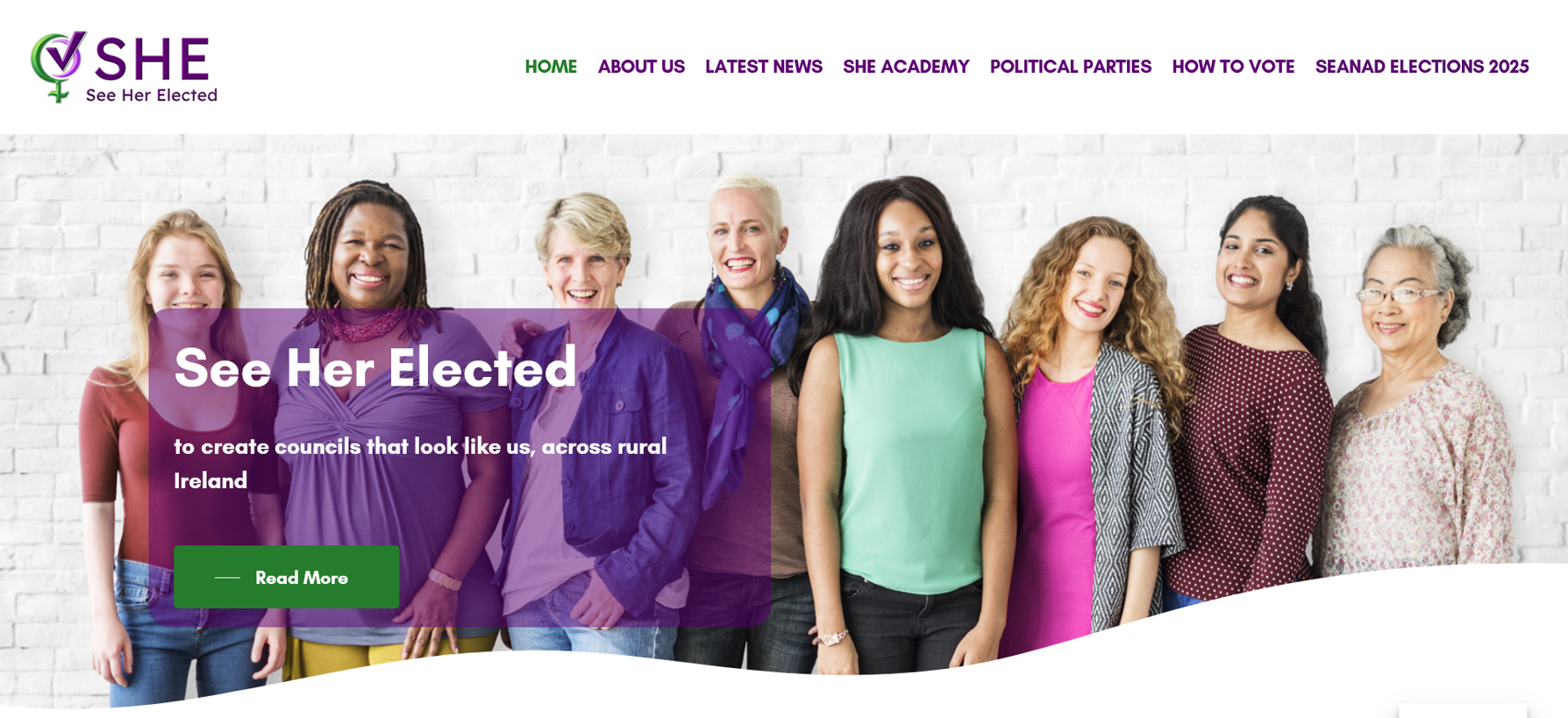
women’s space suits. Other influences included See Her Elected, Nation Women’s Council of Ireland and Women For Election all of which campaign on behalf of women and work tirelessly to make information about gender bias and women in politics available to the public.
people dancing on square

Research & Validation

The initial research for this project in Semester 1 focused on inspiration which can be divided into two categories - the first being topical research on gender bias and the second on creative styles and inspirations.

The research on gender bias identified through primary and secondary sources a gap in the political representation of women, a lack of information on getting involved in politics, inconsistent levels of information available across local authorities in Ireland and a lack of representation of minority groups across political materials.

The creative and inspirational research focused on trending styles for the target audience of women between the ages of 24 and 30, looking at a range of materials from educational campaigns, advertising, consumer goods and luxury goods.

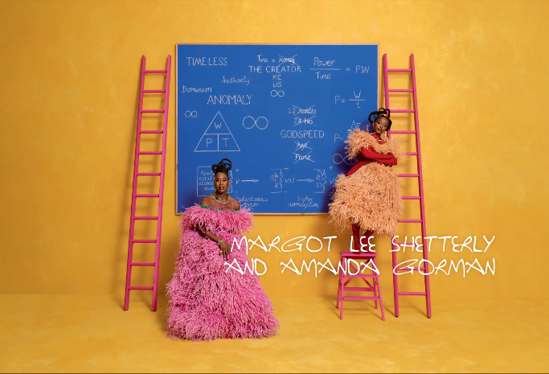
The research validated the need for additional resources for women in politics, with a lively and impactful message, contrasting the drag political imagery of Irish politics. While there was plenty of information available on the issue, most solutions and data focused on national level politics, as well as providing workshops for those already elected. Information for local level politics was either unavailable or inconsistent, resources tended to be paywalled, making it difficult for newcomers to get started.
people dancing on square

Semester 2 research focused on qualitative and quantitative data to ground my work in, and finding a solid design aesthetic for my content.

I reached out to over 70 politicians, political candidates and organisations to conduct interviews and gather my data. Using User Research methods I created a framework that guided my questioning and allowed me to pull meaningful insights from the data collected. Prepping questions that I thought would provide insights into the women’s experiences, I also looked to understand how they would like to see the issue resolved or improved.

Some of the questions are included below:

  • Do you think there are barriers preventing women getting into politics? What do you think those barriers are?
  • What was your biggest fear when starting out in politics or biggest worry?
  • How did you figure out what a councillor does? Did you feel this was an easy topic to learn about?
  • How do you think we should encourage more women into local level politics?
  • What advice would you give young women starting in politics today?

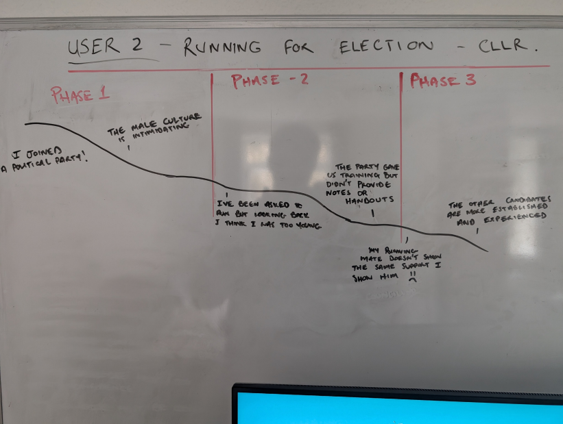
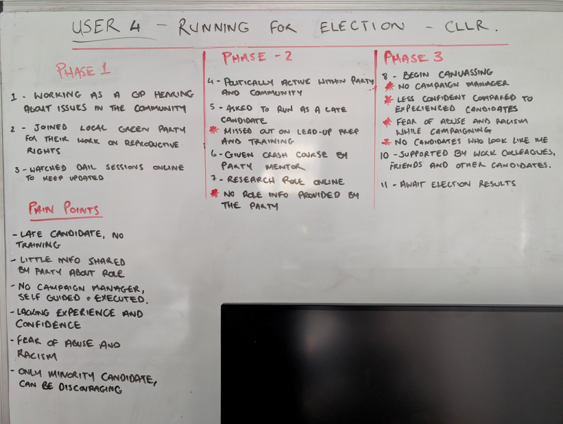
With the information from the interviews on hand, I began qualitative analysis of the data, breaking it down into user journeys, mapping our the mindsets and pain points of the “users”. Overall 5 key themes were identified:

  • Perception of women in politics
  • Lack of confidence among women in politics
  • Time poverty
  • Lack of representation of women
  • Gatekept resources

Using these five themes I started to create problem statements and from the problem statements, I created how might we statements. The aim of this was to broaden my thinking and allow different perspectives to problem solving.

To further understand the “users” and the problems I developed qualitative user personas based on the interviews. Using key information from the interviews to understand their motivations, needs and expectations.

To confirm the information from the interviews was a reflection of the wider population, I employed an additional survey. I based the questions off the five major themes asking respondents a total of 11 questions.

Ideation

Once the initial research had been complete to a satisfactory level, I began looking at potential solutions to the problems I had outlined following the qualitative analysis. I used SCAMPER models (substitute, combine, adapt, modify, put to another use, eliminate, and reverse) to ideate on existing ideas or solutions.

Following this I also began to mind map potential solutions, taking the 5 major themes and outlining different solutions, then how those solutions might be executed.

people dancing on square

Prototyping, Iteration & Testing

As part of the next phase of prototyping I began to explore aesthetics and solutions ideated through the SCAMPER and Mind Mapping methods. This exploration included social media posts, information graphics, an installation style photobooth, toolkits, audio and radio adverts, choose your own adventure style stories, leaflets and website information architecture. In tandem I began to define my message, develop the project branding and define the required artefacts.

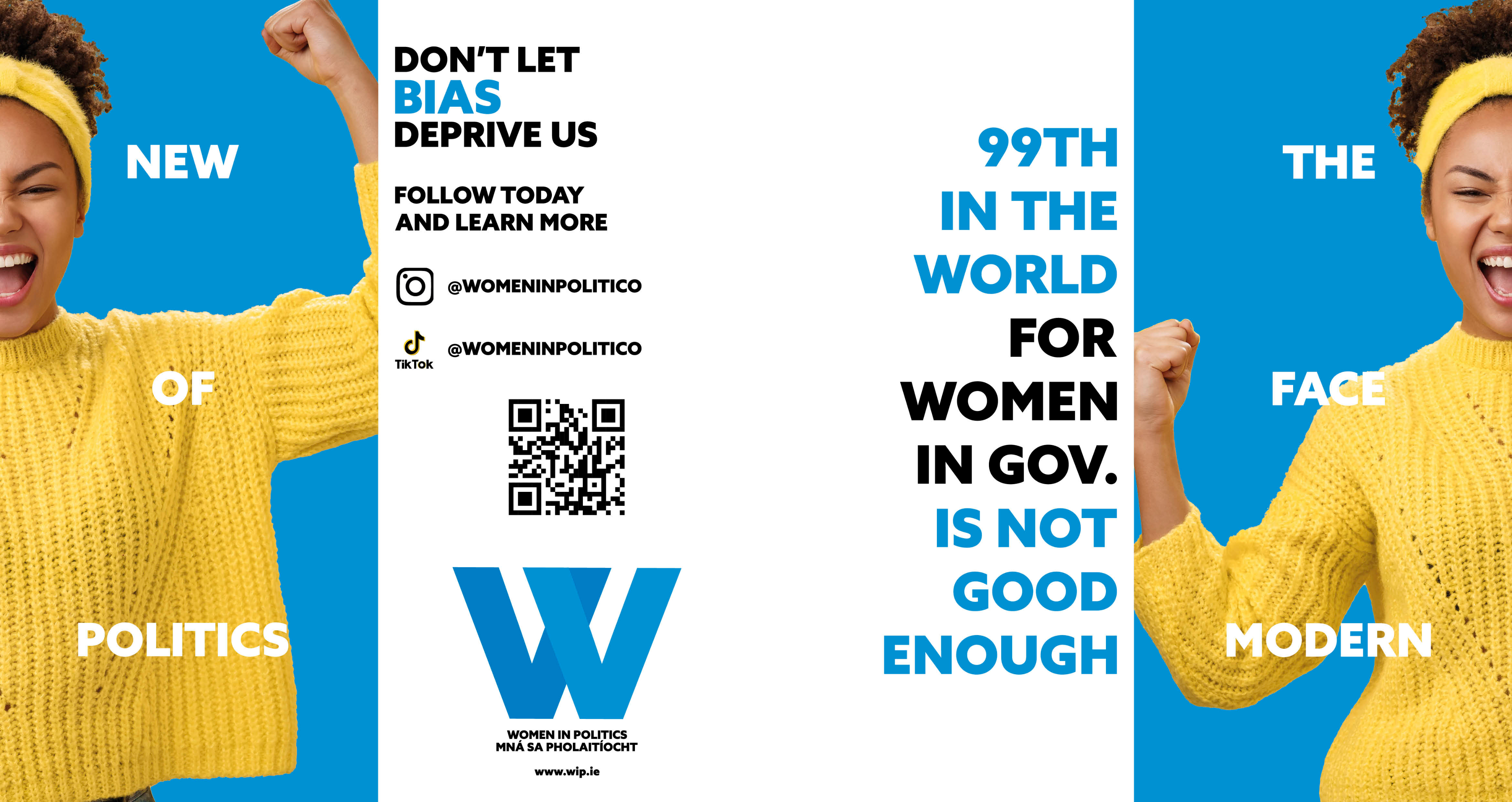
Feedback from my work to date noted that my messaging needed better definition, pointing me to look at examples of activism and the language employed by different movements. I began to iterate on different slogans based around the themes of bias and equality, as well as key information from my interviews. Testing with a small audience helped to narrow down the most relatable messages and from there I created further variation aiming to be catchy concise and conveyed my message.

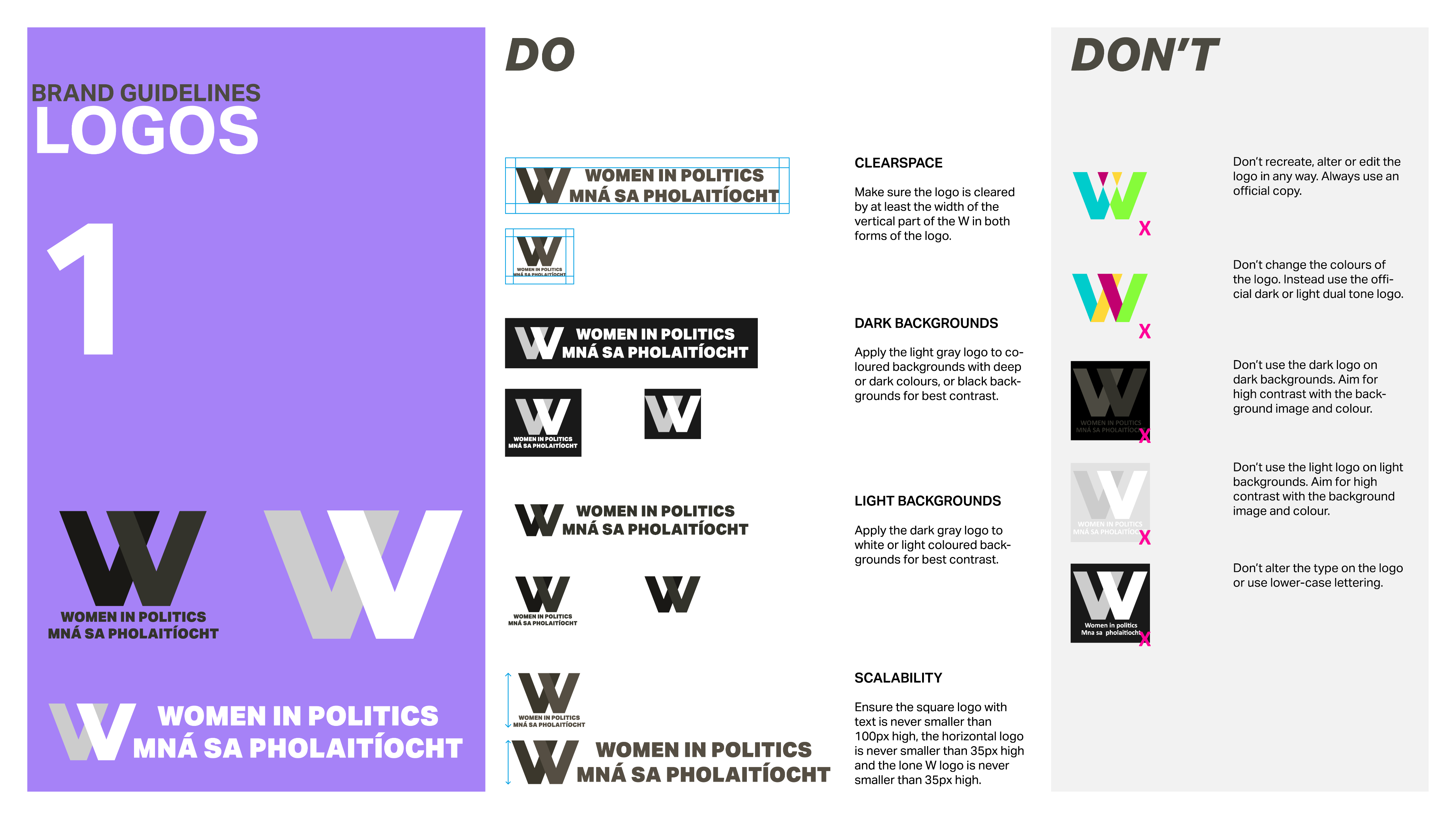
I look at creating a set of brand values for my work to help structure, focus and define my outputs further. I began with outlining my brand values. This work started with outlining the purpose and vision of the project, setting the brands personality, setting it’s guiding principles and finally culminating in the brands defined values. A number of sources were used to build these frameworks, helping to define mission statements and build frameworks. Jennifer Aaker’s five-dimensional model played a part in building the personality of Women In Politics. Researching other brand guidelines such as VIA, IKEA and Discord, I took note of recurring themes and began to create a framework for my own brand guidelines. I created 6 key themes that my work would be based around: Logo, Brand Mark, Typography, Colour, Imagery and Copy & tone.

people dancing on square

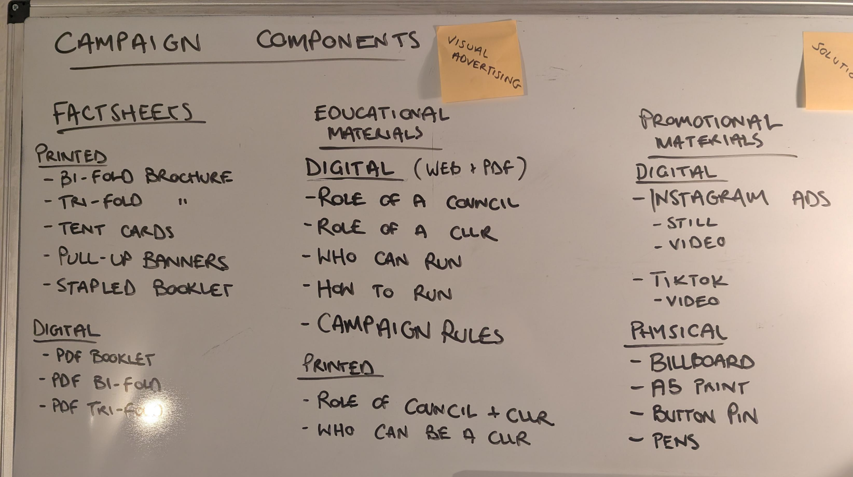
Referencing my previous work researching campaigns and prototyping, I looked to define what artefacts to create as part of my project. Under the four headings of Goals, Resources, Legitimisation and Outreach, I outlined a number of objects that would need to be created in order to have a successful campaign: Objective Statement, Factsheets, Guides, Educational Materials, Testimonials, Partnerships, Social Media Content. Using this foundation I created a number of templates which could be used as part of the project moving forward.

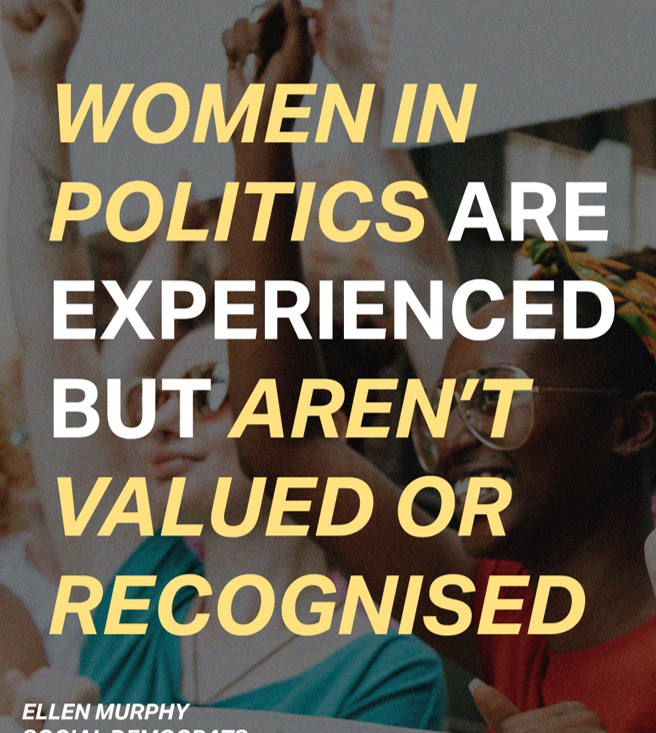
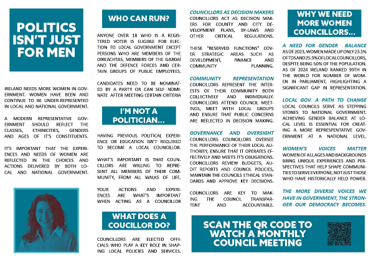
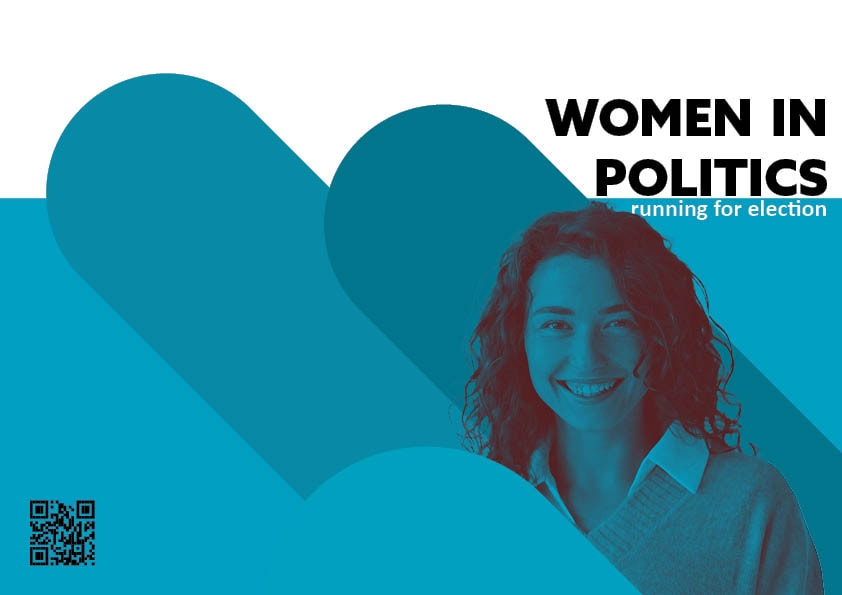
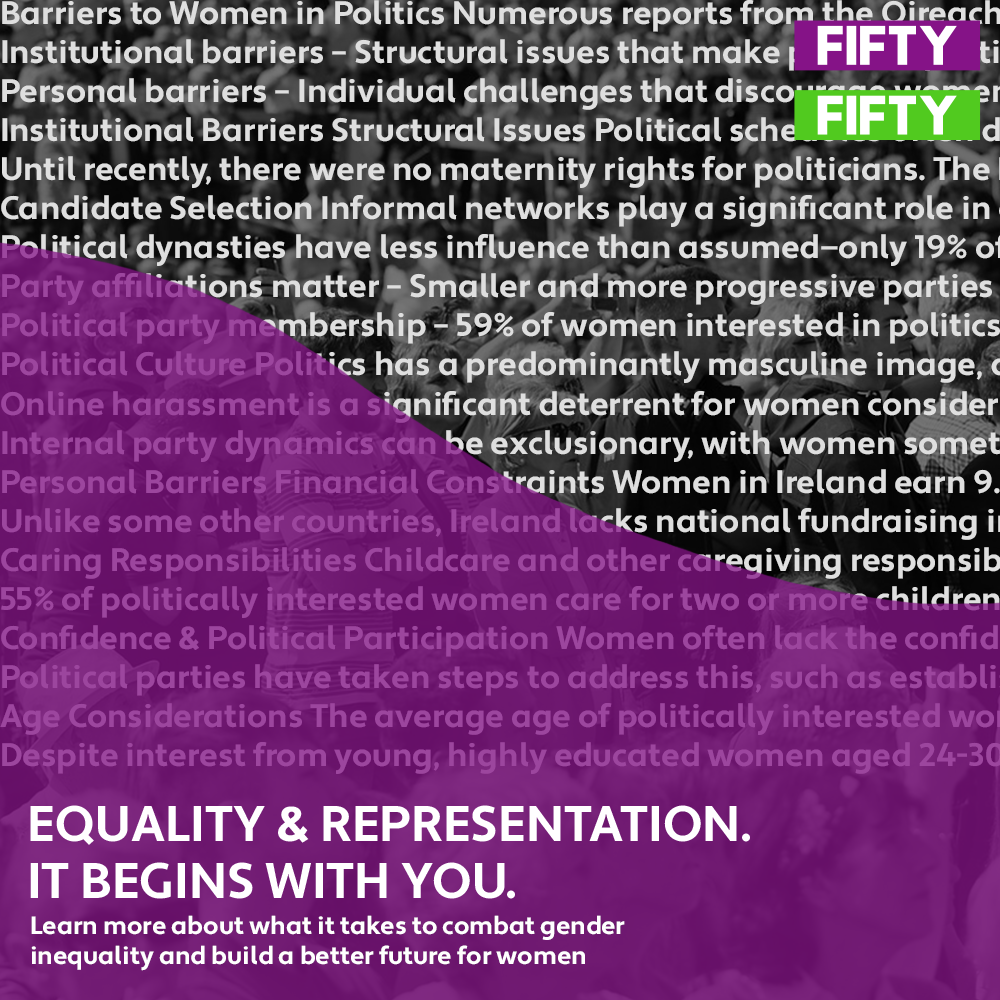
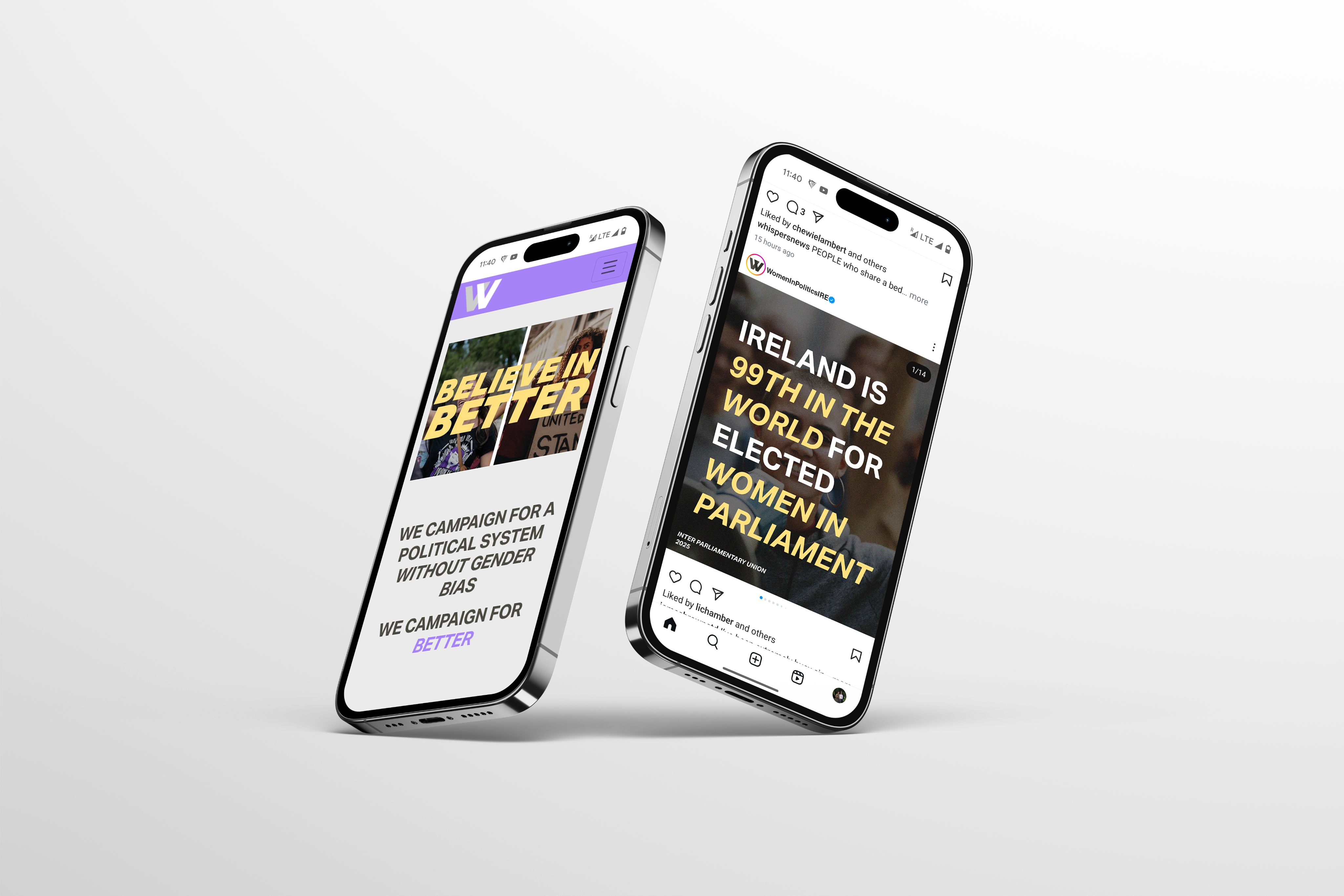
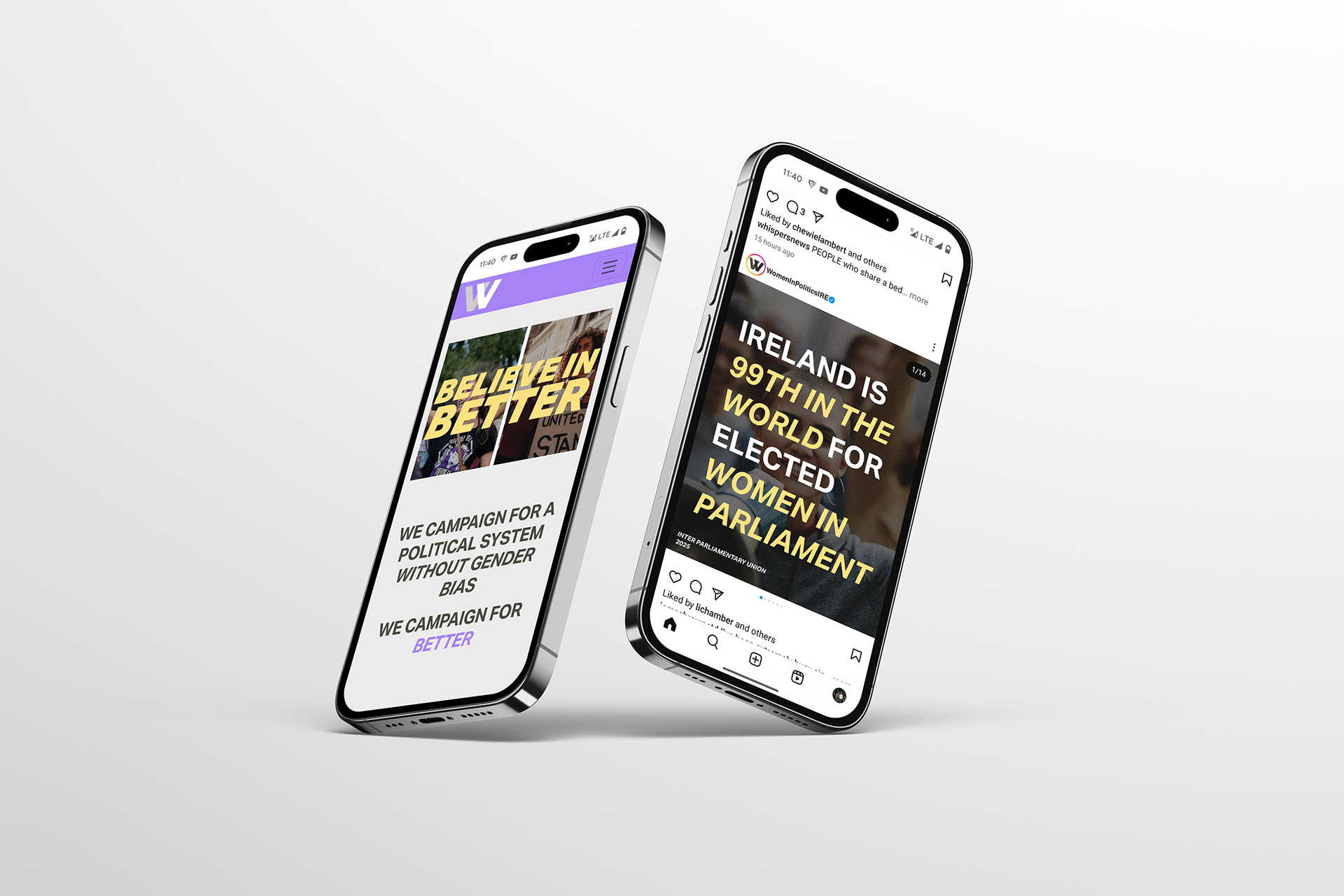
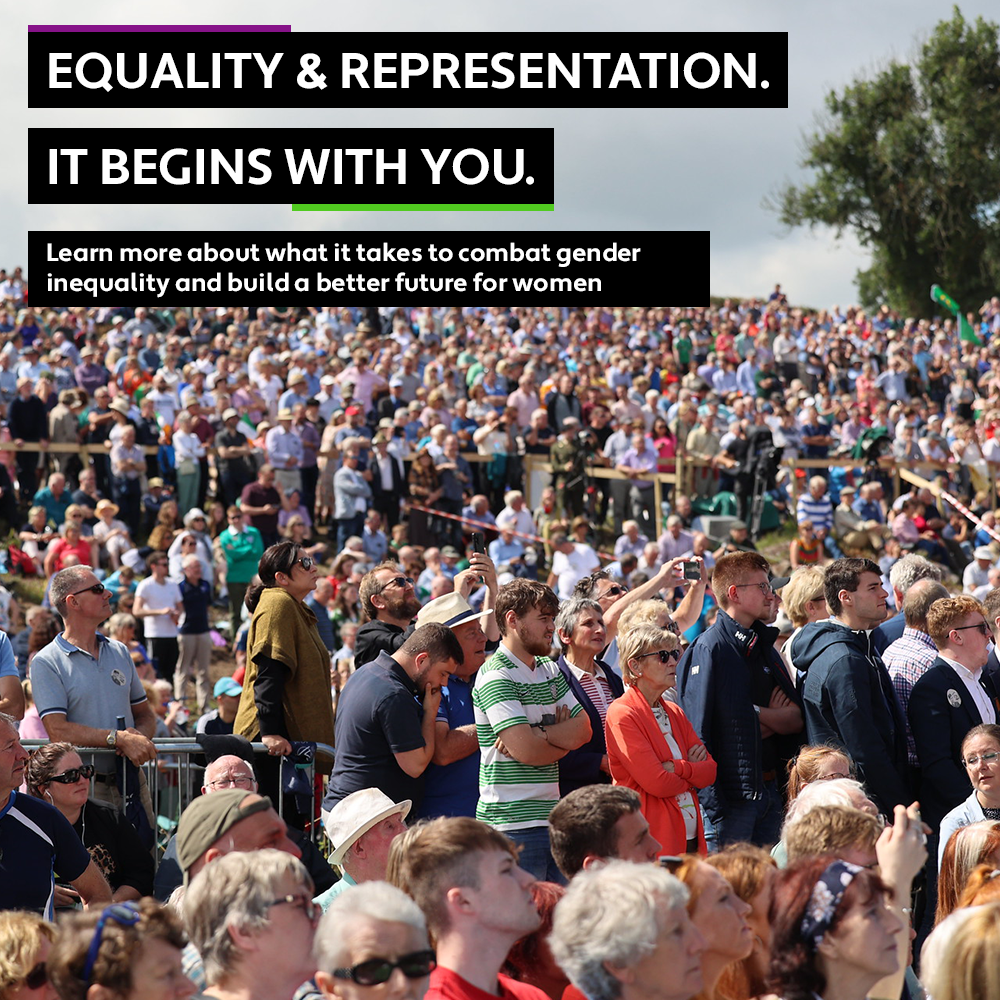
As the end of the project approached I began creating the final artefacts for my project, this consisted of a website, leaflets, posters, social media content and the brand guidelines. While my previous iteration and exploration of aesthetics had helped me to create several templates which I could apply my designs to, other work had to be created from scratch.

For the website I initially mocked up designs based on the information architecture testing in Adobe Illustrator. Once my designs were mocked up I then used HTML Bootstrap to create a central pillar to my work, the Women In Politics website. I chose bootstrap due to my familiarity and due to the structured nature of its layout, using columns and rows to create a uniform website foundation.

The posters, social media posts, brand guidelines and leaflets were all created in Adobe InDesign. This was programme was chosen for its ability to create uniform layouts, the ability to swap content and imagery with ease and the familiarity with creating documents for printing. Other elements of the work such as the logo were created using Adobe Illustrator so that iterations could be easily created at a fast pace. Alongside testing of minimum sizes, contrast, readability, etc.

people dancing on square

More Iteration...

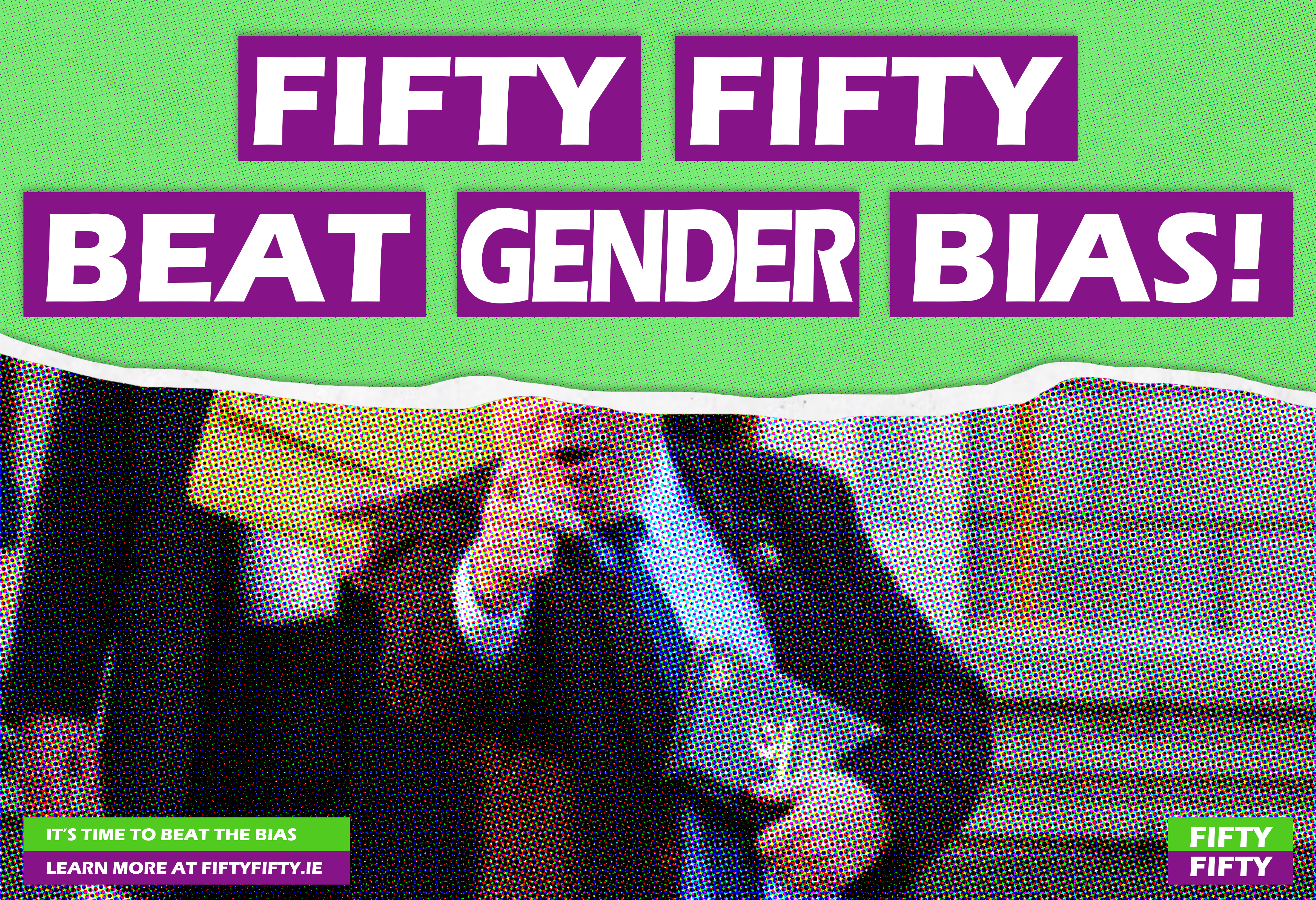
Throughout the second semester the aesthetic of my work changed as the designs evolved through iteration. These changes touched on aesthetics like pop-art, collage, and contemporary 21st century styles. Advice from my supervisor throughout this semester was to “keep iterating”.

The project aesthetics varied greatly as the weeks passed, from the project name to the fonts, the messaging and even the imagery. Some key features however are evident looking back at the work. The use of purple as a prominent colour related to the women’s rights movement has been incorporated in some shape or form since the beginning.

In the week leading upto the project deadline, my work once again took on a new form - the designs to date were described as too masculine and reminiscent of football clubs. In response I took to the drawing board and looked at variations of different colours, trying different combinations of complimentary and triadic complimentary colours to create an energetic and inspiring aesthetic. I landed on a set of complimentary colours for the main body of work, which expanded out to triadic complimentary set for the printed leaflets to create further distinction for the three different artefacts.

people dancing on square

Testing

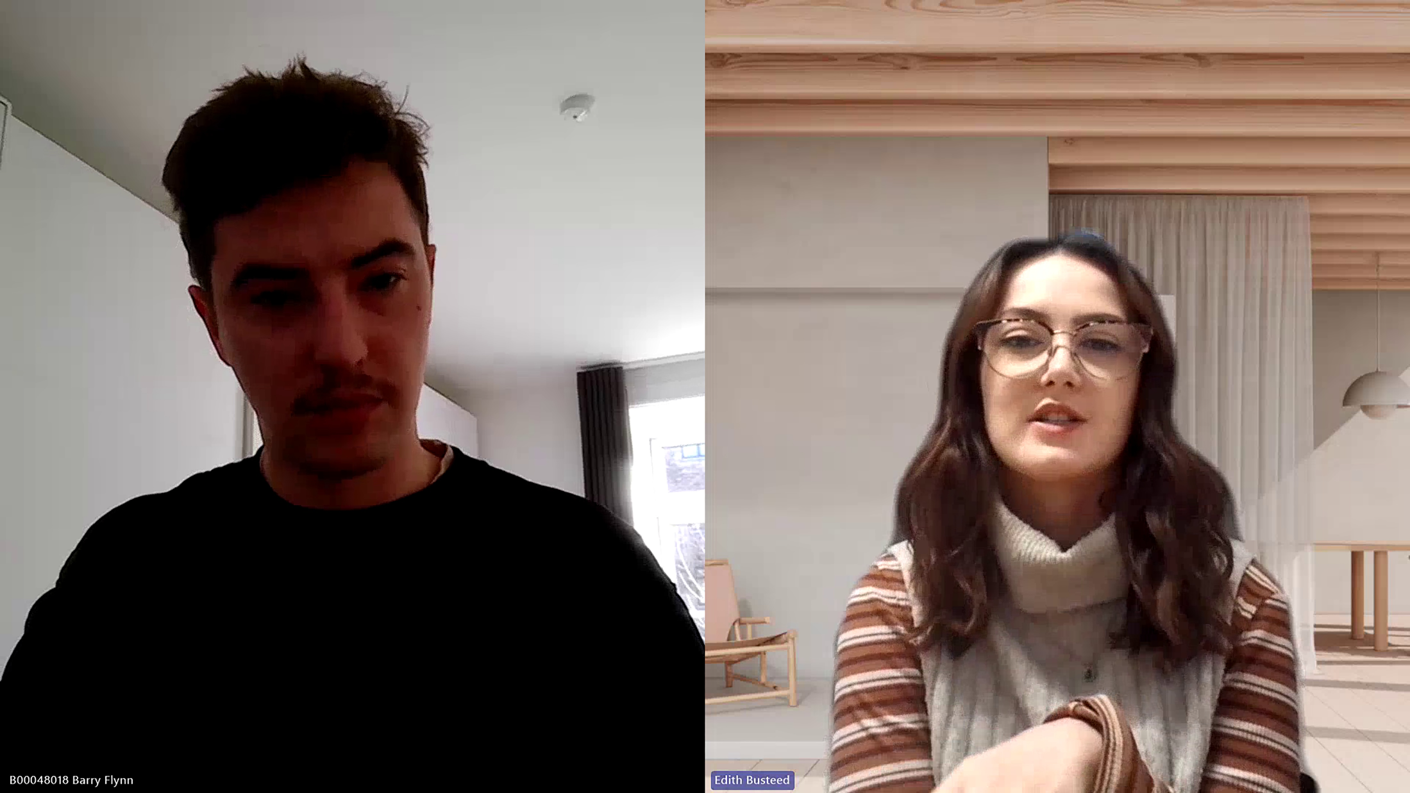
Throughout the semester a group of women between the ages of 24 and 30 were called upon to provide feedback for the project work. This varied from testing the overall language of the project to aesthetic preferences and imagery.

Regular calls were scheduled from the beginning of the semester and carried on through to the final week, however often scheduling issues meant the feedback sessions occurred when and where the testers could make time. The feedback received was often crucial to the project, however there were instances where the group were seemingly unwilling to provide critical feedback.

For website QA testing I had two individuals use the website with several goals in mind:

1. Find three profiles under the stories section of the site

2. Find information on what a councillor does

3. Find information on the rules of an election

4. Visit the barriers section of the website and access the source of two separate facts listed in the

barriers.

This testing proved useful with highlighting small issues including remaining placeholder text that wasn’t updated, references to sources not being included as links, non-functioning links and text which needed to be further refined or corrected.

Similar to the website I had the same individuals review the leaflets and brand guidelines information to review the text in place and check the functionality of the QR codes embedded in the document.

people dancing on square

Reflections

Throughout this project I was challenged, but with this challenge came a large amount of insight into various aspects of digital media, my own skills, thoughts and biases. I’m glad to have been given the opportunity to complete this work and happy to have created a piece of work that I am proud of.

The process of continuous refinement and improvement was at times difficult, however with support from my peers and supervisors I overcame these difficulties and saw the merit in completing them. I have also drawn a lot of knowledge about this subject and also the creative process, the difficulties involved and the amount of effort required to complete such a task by myself.

Were I to undertake this task again I would do a number of things differently - I would look at a wider scope of issues within the topic of gender bias, there are such a large number of challenges and barriers only a small section could be touched upon in my work. Had I the opportunity and access to a greater pool of women involved in local Irish politics I would also

look to create a larger selection of profiles and share more stories of women in politics. I would finally look to have further QA testing of the artefacts created as with the limited testing conducted some issues were not corrected ahead of submission.

From user experience design, to digital design & communication, browse a selection of my creative work below.

More projects

User Experience Design

The Meetings Hub

Explore

Digital Design & Content Creation

Chrysalis Community Drug Project

Explore

User Experience Design

Women In Politics

Explore

User Experience Design

Women In Politics

An educational and awareness campaign dedicated to increasing the number of young women in politics, through raising awareness, inspiring action and the provision of educational resources.

people playing basketball outside

A study in contrasts: light, shadow, and the rhythm of the game.

Background & Problem

Women in Politics is a university project aimed at creating an educational and awareness campaign surrounding women in politics.

Through my research I found that bias permeates everyday life in a range of ways, from childhood gender norms and roles to the diversity of orchestras and the participation of women in politics. This research highlighted a range of eye-opening statistics and research to back up this issue as well as a number of barriers for anyone looking to learn more.

The primary project aim was to highlight the low number of women in politics, the causes of this low participation, and to elevate the current women actively participating in politics. The secondary project aim was to freely provide information about getting involved in politics to individuals that wouldn’t otherwise know where to start.

Project Definition

Through my initial research I decided that I wanted to create a project that had the most potential to positively impact women across the board. I decided that a project involving local level politics that elevates the existing women in Irish politics and encourages young women to see themselves as capable of being politicians, was the right path to achieve this goal. This was to be completed through the use of Digital Media, Print Media and Social Media.

two people sitting on a ledge talking

Venice, and a moment between two.

The Team & Key Influences

As this was a final year university project the research and execution was completed by myself and supervised by my university lecturer Kat Nolan, without Kat’s support my project wouldn’t be what it is today.

Throughout my work, I was supported in my research by politicians, political candidates, non-profit women’s charities, family and friends. All which contributed to my work through interviews, testing and reviews.

Key influences on my work include Caroline Criado Perez’s Invisible Women - a summary of the statistical anomaly of women in wider society. The book exposes data bias in a range of topics, from snow ploughing to healthcare research and

women’s space suits. Other influences included See Her Elected, Nation Women’s Council of Ireland and Women For Election all of which campaign on behalf of women and work tirelessly to make information about gender bias and women in politics available to the public.

people dancing on square

Research & Validation

The initial research for this project in Semester 1 focused on inspiration which can be divided into two categories - the first being topical research on gender bias and the second on creative styles and inspirations.

The research on gender bias identified through primary and secondary sources a gap in the political representation of women, a lack of information on getting involved in politics, inconsistent levels of information available across local authorities in Ireland and a lack of representation of minority groups across political materials.

The creative and inspirational research focused on trending styles for the target audience of women between the ages of 24 and 30, looking at a range of materials from educational campaigns, advertising, consumer goods and luxury goods.

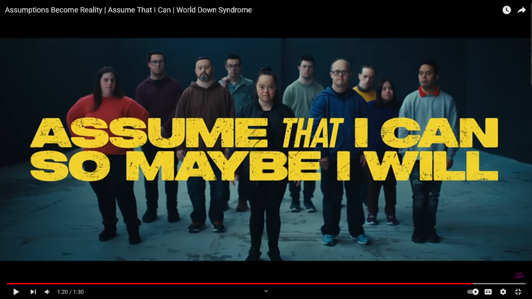
The research validated the need for additional resources for women in politics, with a lively and impactful message, contrasting the drag political imagery of Irish politics. While there was plenty of information available on the issue, most solutions and data focused on national level politics, as well as providing workshops for those already elected. Information for local level politics was either unavailable or inconsistent, resources tended to be paywalled, making it difficult for newcomers to get started.
people dancing on square

Semester 2 research focused on qualitative and quantitative data to ground my work in, and finding a solid design aesthetic for my content.

I reached out to over 70 politicians, political candidates and organisations to conduct interviews and gather my data. Using User Research methods I created a framework that guided my questioning and allowed me to pull meaningful insights from the data collected. Prepping questions that I thought would provide insights into the women’s experiences, I also looked to understand how they would like to see the issue resolved or improved.

Some of the questions are included below:

  • Do you think there are barriers preventing women getting into politics? What do you think those barriers are?
  • What was your biggest fear when starting out in politics or biggest worry?
  • How did you figure out what a councillor does? Did you feel this was an easy topic to learn about?
  • How do you think we should encourage more women into local level politics?
  • What advice would you give young women starting in politics today?

With the information from the interviews on hand, I began qualitative analysis of the data, breaking it down into user journeys, mapping our the mindsets and pain points of the “users”. Overall 5 key themes were identified:

  • Perception of women in politics
  • Lack of confidence among women in politics
  • Time poverty
  • Lack of representation of women
  • Gatekept resources

Using these five themes I started to create problem statements and from the problem statements, I created how might we statements. The aim of this was to broaden my thinking and allow different perspectives to problem solving.

To further understand the “users” and the problems I developed qualitative user personas based on the interviews. Using key information from the interviews to understand their motivations, needs and expectations.

To confirm the information from the interviews was a reflection of the wider population, I employed an additional survey. I based the questions off the five major themes asking respondents a total of 11 questions.

Ideation

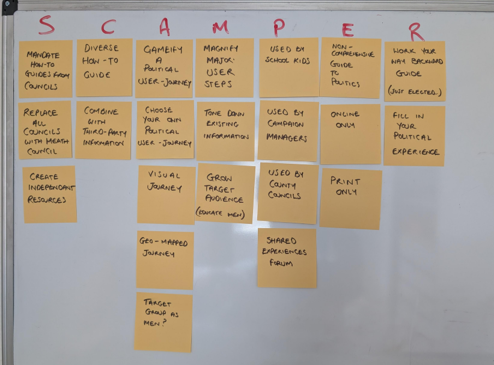
Once the initial research had been complete to a satisfactory level, I began looking at potential solutions to the problems I had outlined following the qualitative analysis. I used SCAMPER models (substitute, combine, adapt, modify, put to another use, eliminate, and reverse) to ideate on existing ideas or solutions.

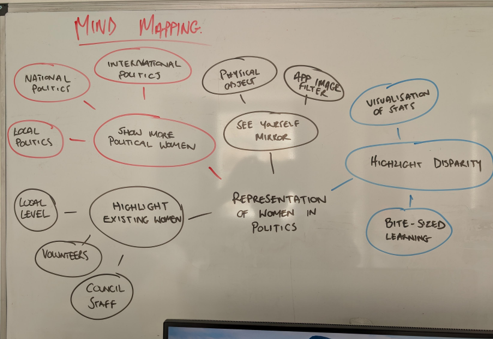
Following this I also began to mind map potential solutions, taking the 5 major themes and outlining different solutions, then how those solutions might be executed.
people dancing on square

Prototyping, Iteration & Testing

As part of the next phase of prototyping I began to explore aesthetics and solutions ideated through the SCAMPER and Mind Mapping methods. This exploration included social media posts, information graphics, an installation style photobooth, toolkits, audio and radio adverts, choose your own adventure style stories, leaflets and website information architecture. In tandem I began to define my message, develop the project branding and define the required artefacts.

Feedback from my work to date noted that my messaging needed better definition, pointing me to look at examples of activism and the language employed by different movements. I began to iterate on different slogans based around the themes of bias and equality, as well as key information from my interviews. Testing with a small audience helped to narrow down the most relatable messages and from there I created further variation aiming to be catchy concise and conveyed my message.

I look at creating a set of brand values for my work to help structure, focus and define my outputs further. I began with outlining my brand values. This work started with outlining the purpose and vision of the project, setting the brands personality, setting it’s guiding principles and finally culminating in the brands defined values. A number of sources were used to build these frameworks, helping to define mission statements and build frameworks. Jennifer Aaker’s five-dimensional model played a part in building the personality of Women In Politics. Researching other brand guidelines such as VIA, IKEA and Discord, I took note of recurring themes and began to create a framework for my own brand guidelines. I created 6 key themes that my work would be based around: Logo, Brand Mark, Typography, Colour, Imagery and Copy & tone.

people dancing on square

Referencing my previous work researching campaigns and prototyping, I looked to define what artefacts to create as part of my project. Under the four headings of Goals, Resources, Legitimisation and Outreach, I outlined a number of objects that would need to be created in order to have a successful campaign: Objective Statement, Factsheets, Guides, Educational Materials, Testimonials, Partnerships, Social Media Content. Using this foundation I created a number of templates which could be used as part of the project moving forward.

As the end of the project approached I began creating the final artefacts for my project, this consisted of a website, leaflets, posters, social media content and the brand guidelines. While my previous iteration and exploration of aesthetics had helped me to create several templates which I could apply my designs to, other work had to be created from scratch.

For the website I initially mocked up designs based on the information architecture testing in Adobe Illustrator. Once my designs were mocked up I then used HTML Bootstrap to create a central pillar to my work, the Women In Politics website. I chose bootstrap due to my familiarity and due to the structured nature of its layout, using columns and rows to create a uniform website foundation.

The posters, social media posts, brand guidelines and leaflets were all created in Adobe InDesign. This was programme was chosen for its ability to create uniform layouts, the ability to swap content and imagery with ease and the familiarity with creating documents for printing. Other elements of the work such as the logo were created using Adobe Illustrator so that iterations could be easily created at a fast pace. Alongside testing of minimum sizes, contrast, readability, etc.

people dancing on square

More Iteration...

Throughout the second semester the aesthetic of my work changed as the designs evolved through iteration. These changes touched on aesthetics like pop-art, collage, and contemporary 21st century styles. Advice from my supervisor throughout this semester was to “keep iterating”.

The project aesthetics varied greatly as the weeks passed, from the project name to the fonts, the messaging and even the imagery. Some key features however are evident looking back at the work. The use of purple as a prominent colour related to the women’s rights movement has been incorporated in some shape or form since the beginning.

In the week leading upto the project deadline, my work once again took on a new form - the designs to date were described as too masculine and reminiscent of football clubs. In response I took to the drawing board and looked at variations of different colours, trying different combinations of complimentary and triadic complimentary colours to create an energetic and inspiring aesthetic. I landed on a set of complimentary colours for the main body of work, which expanded out to triadic complimentary set for the printed leaflets to create further distinction for the three different artefacts.

people dancing on square

Testing

Throughout the semester a group of women between the ages of 24 and 30 were called upon to provide feedback for the project work. This varied from testing the overall language of the project to aesthetic preferences and imagery.

Regular calls were scheduled from the beginning of the semester and carried on through to the final week, however often scheduling issues meant the feedback sessions occurred when and where the testers could make time. The feedback received was often crucial to the project, however there were instances where the group were seemingly unwilling to provide critical feedback.

For website QA testing I had two individuals use the website with several goals in mind:

1. Find three profiles under the stories section of the site

2. Find information on what a councillor does

3. Find information on the rules of an election

4. Visit the barriers section of the website and access the source of two separate facts listed in the

barriers.

This testing proved useful with highlighting small issues including remaining placeholder text that wasn’t updated, references to sources not being included as links, non-functioning links and text which needed to be further refined or corrected.

Similar to the website I had the same individuals review the leaflets and brand guidelines information to review the text in place and check the functionality of the QR codes embedded in the document.

people dancing on square

Reflections

Throughout this project I was challenged, but with this challenge came a large amount of insight into various aspects of digital media, my own skills, thoughts and biases. I’m glad to have been given the opportunity to complete this work and happy to have created a piece of work that I am proud of.

The process of continuous refinement and improvement was at times difficult, however with support from my peers and supervisors I overcame these difficulties and saw the merit in completing them. I have also drawn a lot of knowledge about this subject and also the creative process, the difficulties involved and the amount of effort required to complete such a task by myself.

Were I to undertake this task again I would do a number of things differently - I would look at a wider scope of issues within the topic of gender bias, there are such a large number of challenges and barriers only a small section could be touched upon in my work. Had I the opportunity and access to a greater pool of women involved in local Irish politics I would also

look to create a larger selection of profiles and share more stories of women in politics. I would finally look to have further QA testing of the artefacts created as with the limited testing conducted some issues were not corrected ahead of submission.

From user experience design, to digital design & communication, browse a selection of my creative work below.

More projects

User Experience Design

The Meetings Hub

Explore

abstract painting

Digital Design & Content Creation

Chrysalis Community Drug Project

Explore

User Experience Design

Women In Politics

Explore

User Experience Design

Women In Politics

An educational and awareness campaign dedicated to increasing the number of young women in politics, through raising awareness, inspiring action and the provision of educational resources.

people playing basketball outside

A study in contrasts: light, shadow, and the rhythm of the game.

Background & Problem

Women in Politics is a university project aimed at creating an educational and awareness campaign surrounding women in politics.

Through my research I found that bias permeates everyday life in a range of ways, from childhood gender norms and roles to the diversity of orchestras and the participation of women in politics. This research highlighted a range of eye-opening statistics and research to back up this issue as well as a number of barriers for anyone looking to learn more.

The primary project aim was to highlight the low number of women in politics, the causes of this low participation, and to elevate the current women actively participating in politics. The secondary project aim was to freely provide information about getting involved in politics to individuals that wouldn’t otherwise know where to start.

Project Definition

Through my initial research I decided that I wanted to create a project that had the most potential to positively impact women across the board. I decided that a project involving local level politics that elevates the existing women in Irish politics and encourages young women to see themselves as capable of being politicians, was the right path to achieve this goal. This was to be completed through the use of Digital Media, Print Media and Social Media.

two people sitting on a ledge talking

Venice, and a moment between two.

The Team & Key Influences

As this was a final year university project the research and execution was completed by myself and supervised by my university lecturer Kat Nolan, without Kat’s support my project wouldn’t be what it is today.

Throughout my work, I was supported in my research by politicians, political candidates, non-profit women’s charities, family and friends. All which contributed to my work through interviews, testing and reviews.

Key influences on my work include Caroline Criado Perez’s Invisible Women - a summary of the statistical anomaly of women in wider society. The book exposes data bias in a range of topics, from snow ploughing to healthcare research and

women’s space suits. Other influences included See Her Elected, Nation Women’s Council of Ireland and Women For Election all of which campaign on behalf of women and work tirelessly to make information about gender bias and women in politics available to the public.

people dancing on square

Research & Validation

The initial research for this project in Semester 1 focused on inspiration which can be divided into two categories - the first being topical research on gender bias and the second on creative styles and inspirations.

The research on gender bias identified through primary and secondary sources a gap in the political representation of women, a lack of information on getting involved in politics, inconsistent levels of information available across local authorities in Ireland and a lack of representation of minority groups across political materials.

The creative and inspirational research focused on trending styles for the target audience of women between the ages of 24 and 30, looking at a range of materials from educational campaigns, advertising, consumer goods and luxury goods.

The research validated the need for additional resources for women in politics, with a lively and impactful message, contrasting the drag political imagery of Irish politics. While there was plenty of information available on the issue, most solutions and data focused on national level politics, as well as providing workshops for those already elected. Information for local level politics was either unavailable or inconsistent, resources tended to be paywalled, making it difficult for newcomers to get started.

people dancing on square

Semester 2 research focused on qualitative and quantitative data to ground my work in, and finding a solid design aesthetic for my content.

I reached out to over 70 politicians, political candidates and organisations to conduct interviews and gather my data. Using User Research methods I created a framework that guided my questioning and allowed me to pull meaningful insights from the data collected. Prepping questions that I thought would provide insights into the women’s experiences, I also looked to understand how they would like to see the issue resolved or improved.

Some of the questions are included below:

  • Do you think there are barriers preventing women getting into politics? What do you think those barriers are?
  • What was your biggest fear when starting out in politics or biggest worry?
  • How did you figure out what a councillor does? Did you feel this was an easy topic to learn about?
  • How do you think we should encourage more women into local level politics?
  • What advice would you give young women starting in politics today?

With the information from the interviews on hand, I began qualitative analysis of the data, breaking it down into user journeys, mapping our the mindsets and pain points of the “users”. Overall 5 key themes were identified:

  • Perception of women in politics
  • Lack of confidence among women in politics
  • Time poverty
  • Lack of representation of women
  • Gatekept resources

Using these five themes I started to create problem statements and from the problem statements, I created how might we statements. The aim of this was to broaden my thinking and allow different perspectives to problem solving.

To further understand the “users” and the problems I developed qualitative user personas based on the interviews. Using key information from the interviews to understand their motivations, needs and expectations.

To confirm the information from the interviews was a reflection of the wider population, I employed an additional survey. I based the questions off the five major themes asking respondents a total of 11 questions.

Ideation

Once the initial research had been complete to a satisfactory level, I began looking at potential solutions to the problems I had outlined following the qualitative analysis. I used SCAMPER models (substitute, combine, adapt, modify, put to another use, eliminate, and reverse) to ideate on existing ideas or solutions.

Following this I also began to mind map potential solutions, taking the 5 major themes and outlining different solutions, then how those solutions might be executed.

people dancing on square

Prototyping, Iteration & Testing

As part of the next phase of prototyping I began to explore aesthetics and solutions ideated through the SCAMPER and Mind Mapping methods. This exploration included social media posts, information graphics, an installation style photobooth, toolkits, audio and radio adverts, choose your own adventure style stories, leaflets and website information architecture. In tandem I began to define my message, develop the project branding and define the required artefacts.

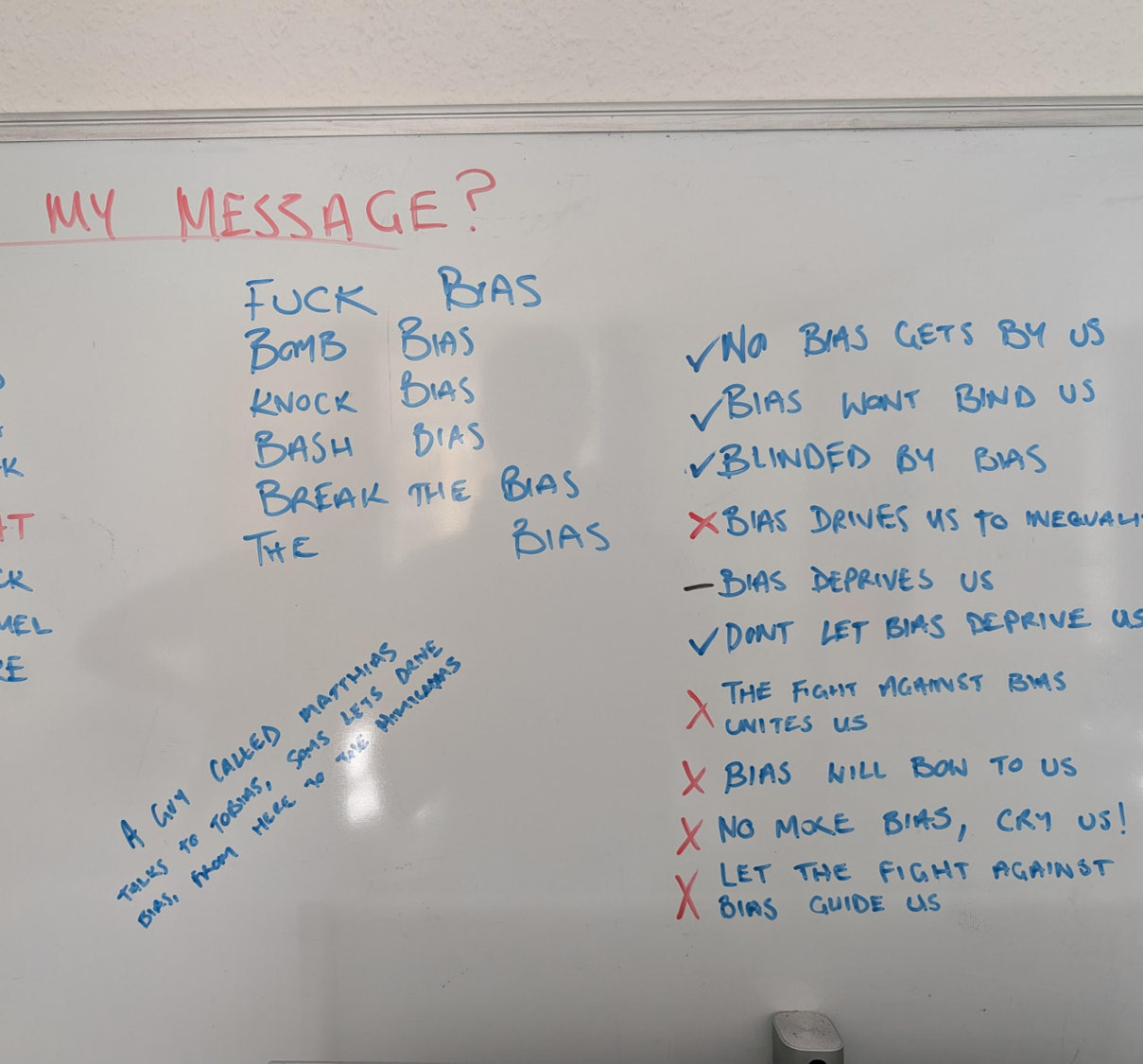
Feedback from my work to date noted that my messaging needed better definition, pointing me to look at examples of activism and the language employed by different movements. I began to iterate on different slogans based around the themes of bias and equality, as well as key information from my interviews. Testing with a small audience helped to narrow down the most relatable messages and from there I created further variation aiming to be catchy concise and conveyed my message.

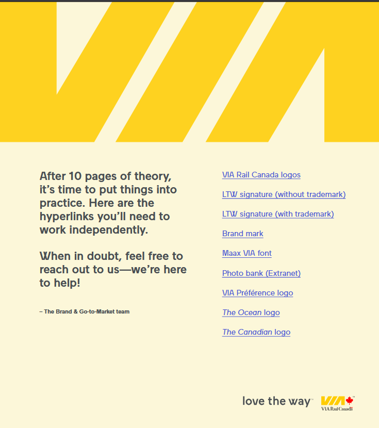
I look at creating a set of brand values for my work to help structure, focus and define my outputs further. I began with outlining my brand values. This work started with outlining the purpose and vision of the project, setting the brands personality, setting it’s guiding principles and finally culminating in the brands defined values. A number of sources were used to build these frameworks, helping to define mission statements and build frameworks. Jennifer Aaker’s five-dimensional model played a part in building the personality of Women In Politics. Researching other brand guidelines such as VIA, IKEA and Discord, I took note of recurring themes and began to create a framework for my own brand guidelines. I created 6 key themes that my work would be based around: Logo, Brand Mark, Typography, Colour, Imagery and Copy & tone.
people dancing on square

Referencing my previous work researching campaigns and prototyping, I looked to define what artefacts to create as part of my project. Under the four headings of Goals, Resources, Legitimisation and Outreach, I outlined a number of objects that would need to be created in order to have a successful campaign: Objective Statement, Factsheets, Guides, Educational Materials, Testimonials, Partnerships, Social Media Content. Using this foundation I created a number of templates which could be used as part of the project moving forward.

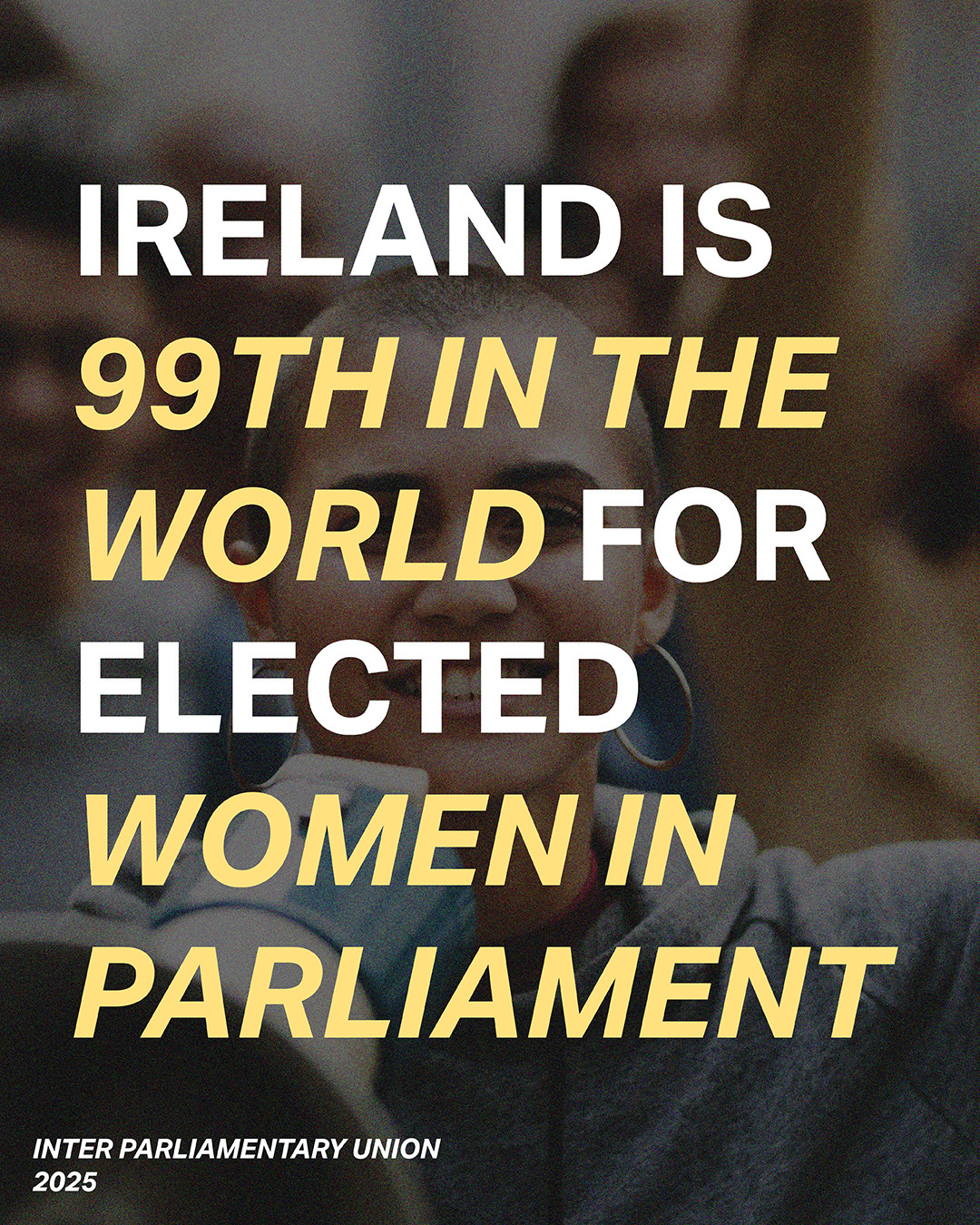
As the end of the project approached I began creating the final artefacts for my project, this consisted of a website, leaflets, posters, social media content and the brand guidelines. While my previous iteration and exploration of aesthetics had helped me to create several templates which I could apply my designs to, other work had to be created from scratch.

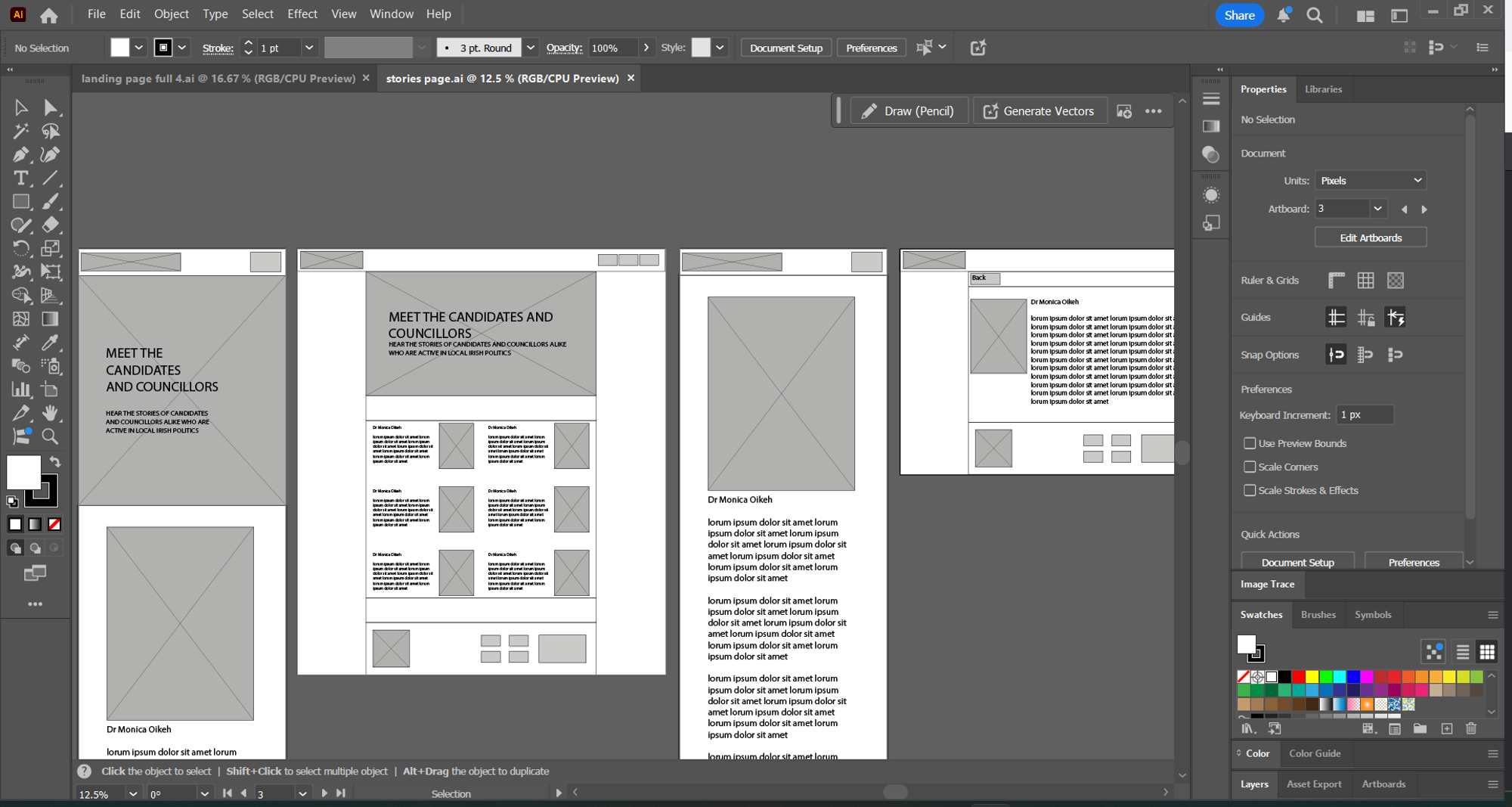
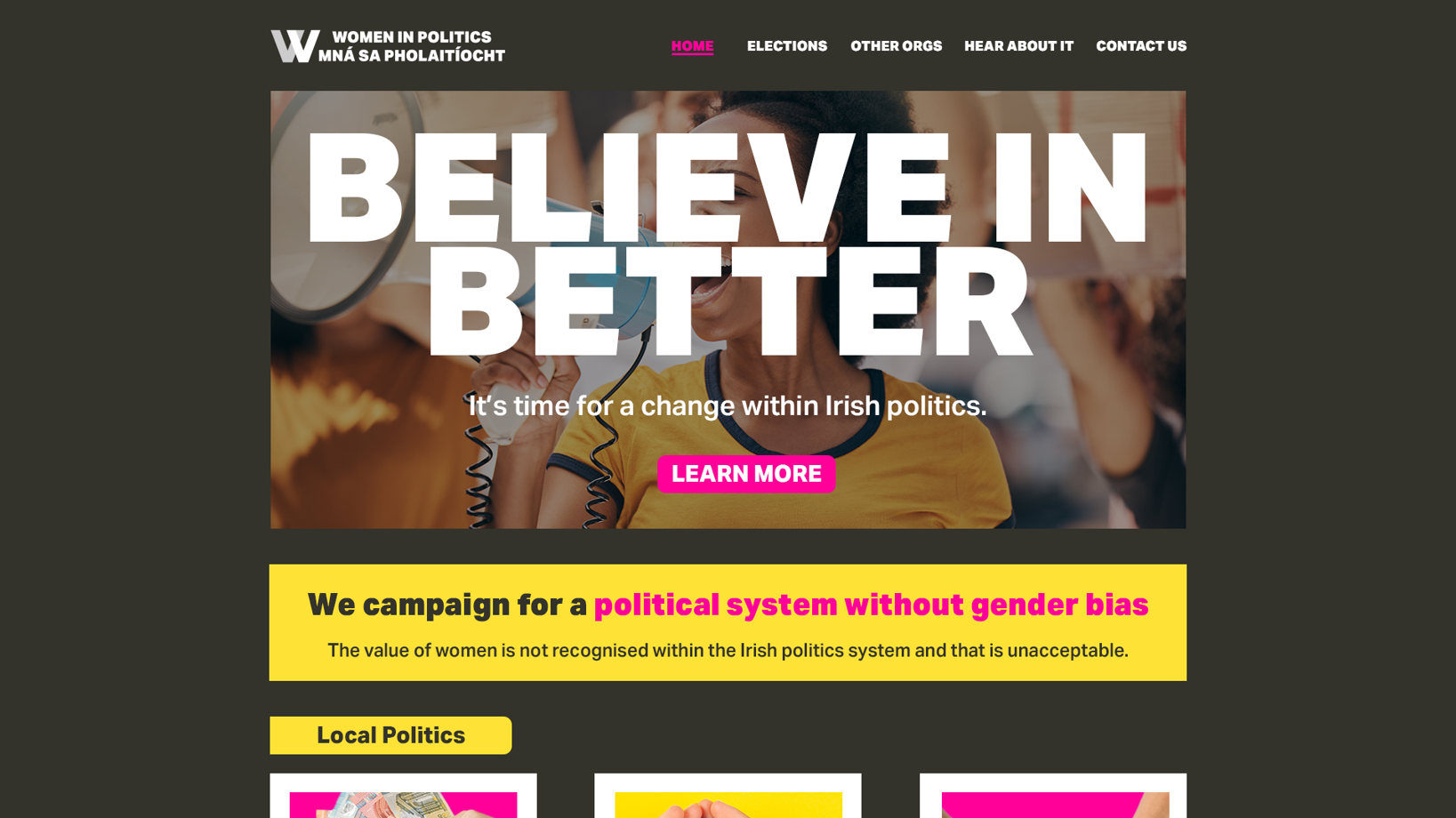
For the website I initially mocked up designs based on the information architecture testing in Adobe Illustrator. Once my designs were mocked up I then used HTML Bootstrap to create a central pillar to my work, the Women In Politics website. I chose bootstrap due to my familiarity and due to the structured nature of its layout, using columns and rows to create a uniform website foundation.

The posters, social media posts, brand guidelines and leaflets were all created in Adobe InDesign. This was programme was chosen for its ability to create uniform layouts, the ability to swap content and imagery with ease and the familiarity with creating documents for printing. Other elements of the work such as the logo were created using Adobe Illustrator so that iterations could be easily created at a fast pace. Alongside testing of minimum sizes, contrast, readability, etc.
people dancing on square

More Iteration...

Throughout the second semester the aesthetic of my work changed as the designs evolved through iteration. These changes touched on aesthetics like pop-art, collage, and contemporary 21st century styles. Advice from my supervisor throughout this semester was to “keep iterating”.

The project aesthetics varied greatly as the weeks passed, from the project name to the fonts, the messaging and even the imagery. Some key features however are evident looking back at the work. The use of purple as a prominent colour related to the women’s rights movement has been incorporated in some shape or form since the beginning.

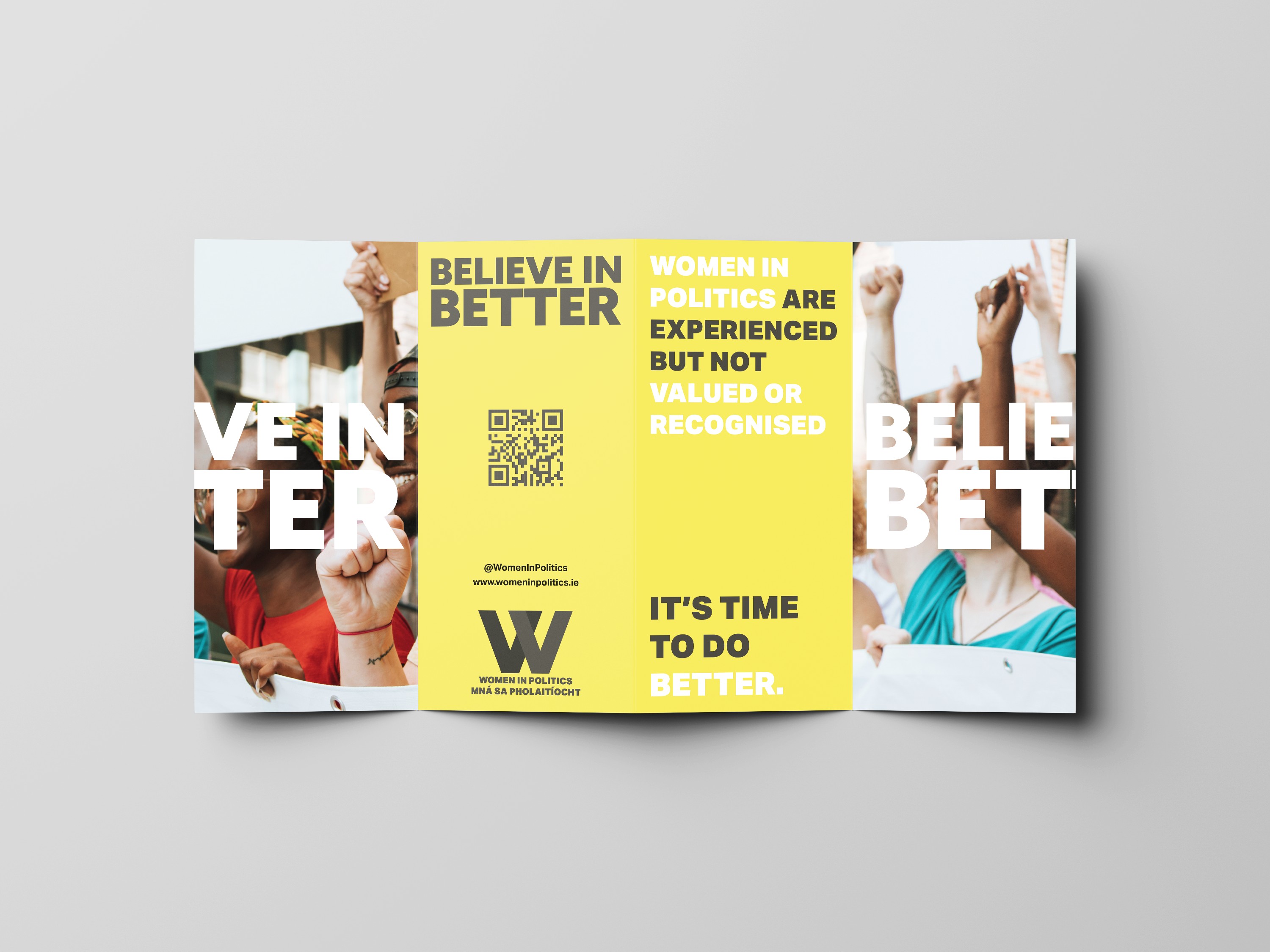
In the week leading upto the project deadline, my work once again took on a new form - the designs to date were described as too masculine and reminiscent of football clubs. In response I took to the drawing board and looked at variations of different colours, trying different combinations of complimentary and triadic complimentary colours to create an energetic and inspiring aesthetic. I landed on a set of complimentary colours for the main body of work, which expanded out to triadic complimentary set for the printed leaflets to create further distinction for the three different artefacts.

people dancing on square

Testing

Throughout the semester a group of women between the ages of 24 and 30 were called upon to provide feedback for the project work. This varied from testing the overall language of the project to aesthetic preferences and imagery.

Regular calls were scheduled from the beginning of the semester and carried on through to the final week, however often scheduling issues meant the feedback sessions occurred when and where the testers could make time. The feedback received was often crucial to the project, however there were instances where the group were seemingly unwilling to provide critical feedback.

For website QA testing I had two individuals use the website with several goals in mind:

1. Find three profiles under the stories section of the site

2. Find information on what a councillor does

3. Find information on the rules of an election

4. Visit the barriers section of the website and access the source of two separate facts listed in the

barriers.

This testing proved useful with highlighting small issues including remaining placeholder text that wasn’t updated, references to sources not being included as links, non-functioning links and text which needed to be further refined or corrected.

Similar to the website I had the same individuals review the leaflets and brand guidelines information to review the text in place and check the functionality of the QR codes embedded in the document.
people dancing on square

Reflections

Throughout this project I was challenged, but with this challenge came a large amount of insight into various aspects of digital media, my own skills, thoughts and biases. I’m glad to have been given the opportunity to complete this work and happy to have created a piece of work that I am proud of.

The process of continuous refinement and improvement was at times difficult, however with support from my peers and supervisors I overcame these difficulties and saw the merit in completing them. I have also drawn a lot of knowledge about this subject and also the creative process, the difficulties involved and the amount of effort required to complete such a task by myself.

Were I to undertake this task again I would do a number of things differently - I would look at a wider scope of issues within the topic of gender bias, there are such a large number of challenges and barriers only a small section could be touched upon in my work. Had I the opportunity and access to a greater pool of women involved in local Irish politics I would also

look to create a larger selection of profiles and share more stories of women in politics. I would finally look to have further QA testing of the artefacts created as with the limited testing conducted some issues were not corrected ahead of submission.
From user experience design, to digital design & communication, browse a selection of my creative work below.

More projects

User Experience Design

The Meetings Hub

Explore

abstract painting

Digital Design & Content Creation

Chrysalis Community Drug Project

Explore

magazine spread

User Experience Design

Women In Politics

Explore